
While traditional CRM systems do a good job of storing customer data, they often fall short when it comes to actively growing revenue. Think of a revenue layer as the smart upgrade your CRM needs; it’s like adding a brain that can make quick decisions and handle complex tasks automatically. By connecting your sales processes, from quotes to renewals, this layer creates a clear picture that helps close deals faster and keeps customers happy. For SaaS companies looking to turn basic customer management into money-making opportunities, the difference between a standard CRM and a revenue layer could mean the difference between staying afloat and really taking off.
Why Trust Our Revenue Layer Expertise?
At SAASTEPS, we’ve been pioneering revenue lifecycle management solutions since 2012, with our co-founders Tim Beck and Ron Costa bringing over two decades of industry experience to the table. Our expertise isn’t just theoretical; we’ve developed a non-provisional patent-pending solution that’s transformed how SaaS companies manage their entire revenue lifecycle, from quoting, billing to automated renewals.
Our deep understanding of revenue layer technology comes from hands-on experience solving real-world challenges for countless SaaS (Subscription) businesses. We’ve built a comprehensive application (Managed Package) that operates on a single-data model, unifying the entire revenue lifecycle without requiring custom code or complex integrations. This practical experience has given us unique insights into why traditional CRM systems alone aren’t enough for modern SaaS (Subscription) companies, and how a properly implemented revenue layer can transform business operations.
Understanding Revenue Layer vs CRM: The Strategic Difference
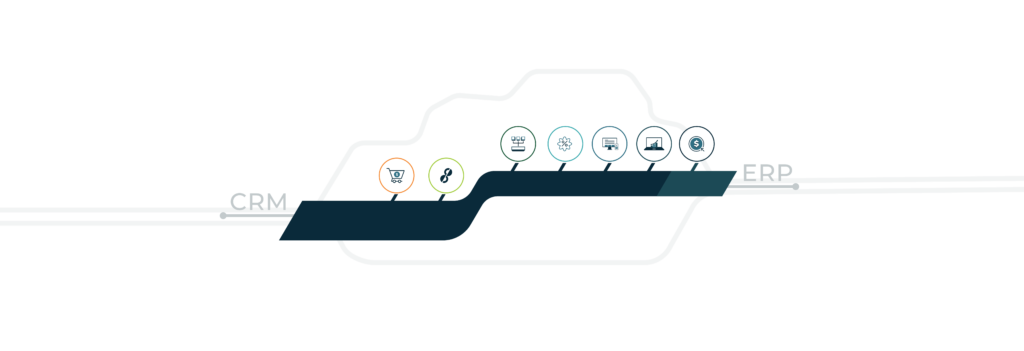
Revenue Layer platforms provide SaaS (Subscription) companies with specialized functionality that traditional CRM systems lack, particularly in managing subscription lifecycles, automated billing processes, and comprehensive renewals lifecycle management that drive predictable growth.
CRM systems struggle to meet the needs of today’s SaaS (Subscription) companies, especially when handling complex pricing, billing, and renewals processes. In fact, approximately 20% of organizations report that traditional CRM systems fail to effectively align with complex billing and renewal processes in SaaS environments, leading to operational inefficiencies (Migdadi, 2020). This is where a Revenue Layer steps in, acting as a robust tool to drive strategic growth.
Unlike CRM, a Revenue Layer integrates key components like contracts, subscriptions, and detailed revenue reporting all in one place.
What Makes CRM Systems Fall Short for Modern SaaS
Traditional systems often miss the mark when it comes to managing the complex needs of modern SaaS companies. CRM systems, while great for handling customer data and streamlining the sales process, fall short in key areas vital for SaaS businesses.
Research shows that conventional CRM systems are particularly limited in their ability to deliver personalized customer experiences and drive engagement through automation (Abubakar et al., 2025). They aren’t built to handle the intricacies of subscription management, complex billing structures, or the dynamic nature of SaaS renewals. Furthermore, CRMs often create siloed data, making it tough to get a comprehensive view of the customer lifecycle.
Consider the following challenges in CRM systems:
| Issue | CRM Shortcoming | Revenue Layer Solution |
| Billing | Can’t handle complex billing models | Unifies billing and payments |
| Renewals | Manual renewal processes | Automates renewal workflows |
| Data Silos | Customer data is fragmented | Centralizes customer data |
CRM systems aren’t designed to manage the revenue lifecycle from start to finish. They don’t automate processes like quoting, contract management, or revenue reporting. This is where a revenue layer excels, automating these processes and providing a single source of truth for all customer and revenue data. It’s time to move beyond the limitations of CRM and embrace a solution built for the modern SaaS landscape.
How Revenue Layer Functions as a Strategic Growth Enabler
Moving beyond the limitations of current systems, SaaS companies are exploring tools that don’t just store data but drive growth. A revenue layer, functioning as a strategic growth enabler, does exactly that. It transforms raw data into actionable perspectives, a process known as revenue intelligence.
Unlike traditional CRM systems that merely manage customer interactions, a revenue layer orchestrates the entire revenue lifecycle. Acting as a revenue orchestration platform, it automates and integrates key processes like quoting, billing, and renewals. While these automated systems streamline operations, they require strategic managerial oversight at critical decision points to ensure optimal outcomes (Egan & Haynes, 2019).
This means no more struggling with siloed, unstructured data. Instead, teams can focus on what they do best: driving sales, improving customer retention, and accelerating growth, while maintaining the crucial balance between automated efficiency and human insight in revenue management.
Key Components That Set Revenue Layer Apart
How exactly does a revenue layer differ from a CRM, and why is it a strategic breakthrough? Unlike CRM, which focuses mainly on managing customer interactions, a revenue layer broadens the scope to streamline the entire revenue lifecycle.
Key components set it apart. First, it integrates siloed data from various departments, ensuring smooth collaboration among revenue teams. This means no more juggling between different tools for quotes, billing, and renewals. Everything’s centralized, making processes swift and error-free.
Additionally, automation powers the revenue layer. It’s not just about tracking interactions; it’s about driving actions that boost revenue. Automated workflows advance contracts, invoices, and payments without manual hassles.
Finally, it delivers real-time insights, letting leaders pinpoint bottlenecks and optimize strategies swiftly. This proactive approach transforms how modern SaaS companies manage and grow their revenue, leaving CRM capabilities in the dust.
It’s not just about tracking sales; it’s about propelling them forward.
SAASTEPS Revenue Lifecycle Solutions: A Case Study in Revenue Layer Innovation
In developing our Revenue Lifecycle Solutions, we recognized the critical need for a unified platform that could seamlessly manage the entire revenue operation cycle. Our solution emerged from understanding that businesses needed more than just data storage; they needed a transformation tool that could automate processes while providing real-time insights.
Through implementing a drag-and-drop interface, we created a platform that simplifies complex operations, allowing businesses to manage seven distinct products through one dashboard. This approach has proven particularly effective in preventing revenue leakage through automated renewal processes, a key pain point we identified in traditional CRM systems.
Why SaaS Companies Are Moving Beyond Traditional CRM
Traditional CRMs fall short in handling the complex revenue models and subscription lifecycles of SaaS companies. Research shows that SaaS businesses leveraging optimized revenue models through specialized CRM tools achieve significantly higher customer lifetime value compared to those using traditional platforms (Wulf et al., 2021).
To build business resilience, especially during economic uncertainty, SaaS companies are turning to revenue layers that integrate revenue intelligence with product-led growth strategies. This shift addresses the challenges in quoting, billing, and renewals, enabling a more structured and automated revenue lifecycle.
Managing Complex SaaS Revenue Models and Subscription Lifecycles
Managing the complex maze of SaaS revenue streams and subscription lifecycles presents a formidable challenge for many companies. Customer success teams often grapple with quoting, billing, and renewals, leading to inefficiencies and lost revenue. Traditional CRM systems can’t handle the intricacy of modern SaaS revenue models, especially considering that successful SaaS companies with revenues above $100 million achieve median growth rates of 22 percent, with top performers exceeding 40 percent growth (Gnanasambandam et al., 2022).
That’s why companies are turning to dedicated revenue management software. This software helps unwind siloed, unstructured data systems, providing a clear view of the entire revenue lifecycle. It automates processes like commerce, payments, CPQ, subscriptions, contracts, billing, invoicing, renewals, and revenue reporting.
Revenue Layer as Backbone for Business Resilience During Economic Uncertainty
Although traditional CRM systems have long been the go-to for managing customer relationships, SaaS companies are increasingly finding them lacking in the face of economic uncertainty. A revenue layer offers a foundation for business resilience, providing real-time insights and automation that CRMs alone can’t match.
Here’s why:
- Accurate Sales Forecasts: Traditional CRMs often rely on manual data entry, leading to outdated or inaccurate sales forecasts. A revenue layer automates this process, giving you a precise picture of expected revenue.
- Deal Velocity: Track deal progress in real-time and identify bottlenecks. Unlike CRMs, a revenue layer can automate tasks, speeding up deal closure.
- Automated Billing: Don’t let manual billing processes slow you down. A revenue layer ensures smooth, timely billing, reducing errors and improving cash flow.
- Streamlined Renewals: CRMs often fall short in managing subscription lifecycles. A revenue layer automates renewals, reducing churn and securing your revenue base.
With a revenue layer, you’re not just organizing customer data; you’re driving growth and ensuring stability during economic fluctuations. It’s time to move beyond traditional CRM and embrace a sturdy revenue layer for your SaaS company.
Integrating Revenue Intelligence with Product-Led Growth Strategies
SaaS companies aren’t sticking with traditional CRMs anymore. They’re embedding revenue intelligence right into their products, creating a seamless experience for users.
Embedding Revenue Orchestration in Self-Service Product Experiences
Traditional CRM systems aren’t cutting it anymore. Today’s SaaS companies need to embed revenue orchestration right into their self-service product experiences. By doing this, they can make the most of their product analytics and relationship intelligence. Here’s how:
- Automate quoting (CPQ): Make it easy for users to get quotes on their own. No more back-and-forth with sales reps.
- Simplify billing: Let users manage their own payments. Less hassle for them, fewer headaches for you.
- Streamline renewals: Automate the renewal process. Keep customers longer, with less effort.
- Unify data: Break down data silos. Make sure all your tools talk to each other, so you can see the big picture.
This isn’t just about making life easier for customers. It’s about driving growth and transforming your revenue lifecycle. It’s about turning data into dollars.
Engineering Customer Lifetime Value Through Dynamic Journey Optimization
Integrating revenue intelligence with product-led growth strategies is becoming a must for companies aiming to boost their customer lifetime value.
By focusing on dynamic journey optimization, SaaS businesses can actively shape customer experiences at every touchpoint. This approach uses real-time data to streamline tasks like quoting, billing, and renewals, turning them from chores into opportunities.
It’s not about guessing what customers want; it’s about knowing and delivering. Traditional CRMs just store data, but a revenue layer acts on it, driving growth and retention.
Don’t just collect data; put it to work.
Implementation Strategy: Revenue Layer and CRM Integration
Implementing a revenue layer doesn’t mean kicking your CRM to the curb; it’s about making them work together. This integration demands a shift in how your teams interact and collaborate, from the top down.
Choosing the right revenue layer solution is vital, so don’t just go with the shiniest one in the bunch.
How Revenue Layer Complements Rather Than Replaces CRM
When a SaaS company wants to streamline its revenue processes, it might seem like a choice has to be made between using a CRM or a Revenue Layer. However, this isn’t an either/or situation. A Revenue Layer actually complements a CRM, enhancing its capabilities.
Here’s how:
- Unified View: A Revenue Layer integrates data from sales operations, finance, and other departments, providing a single source of truth.
- Automation: It automates complex processes like quoting, billing, and renewals, reducing manual errors and speeding up sales revenue cycles.
- Data Structuring: It helps structure and organize data, making it easier to access and analyze.
- Revenue Intelligence: By providing real-time revenue reporting, it helps identify trends and opportunities, aiding better decision-making.
Cultural Transformation and Cross-Functional Collaboration Requirements
Implementing a revenue layer isn’t just about tech; it’s about people. Cultural transformation is vital. Silos happen when teams don’t talk.
Sales, marketing, and post-sale teams must work together. Cross-functional collaboration can’t be an afterthought. It’s the foundation of effective revenue management. To enhance revenue management capabilities, organizations should implement broad learning programs that emphasize cross-training across functional areas (Sinha et al., 2022).
Automating the revenue lifecycle, from CPQ to renewals, requires everyone to be on the same page. That means breaking down walls between departments. It’s tough, but necessary.
The first step? Open communication channels. Regular meetings where all teams share updates are a must. Use simple, shared tools that everyone can understand. This approach fosters an innovative and collaborative environment that drives success (Sinha et al., 2022).
Make sure everyone knows their role and how it fits into the bigger picture. Leaders must champion this change. It’s not just about buying new software; it’s about using it right.
Transformation isn’t easy, but it’s worth it. It makes the revenue lifecycle smoother and stops data from getting messy.
Choosing the Right Revenue Layer Solution for Your SaaS Business
When integrating a revenue layer with your CRM, consider the privacy considerations of consolidating customer data. Trust is vital; guarantee your data integration is ethical and transparent.
Don’t overlook the potential risks of data breaches or misuse, as they can greatly impact your business reputation and customer loyalty.
Privacy, Trust, and Ethical Data Integration Considerations
- Adherence to Standards
Ensure that your data integration complies with all necessary regulations and standards, including GDPR, CCPA, and HIPAA.
- Data Security Protocols
Implement resilient security protocols to protect customer data. This includes encryption, secure access controls, and regular audits.
- Transparency
Communicate clearly with your customers about how their data is being used and stored. Transparency builds trust.
- Ethical Considerations
Respect customer privacy. Avoid practices that could be construed as unethical or invasive.
Frequently Asked Questions
What Is the Initial Setup Cost of a Revenue Layer?
The initial setup cost of a revenue layer varies greatly depending on the specific software chosen, the size of the business, and the level of customization required. On average, it can range from $5,000 to $50,000 or more. This includes software licensing fees, implementation services, and initial configuration costs. Furthermore, there may be internal costs associated with training staff and integrating the revenue layer with existing systems. Ongoing costs such as subscription fees and maintenance should also be considered.
How Does a Revenue Layer Impact Customer Data Privacy?
A revenue layer can impact customer data privacy as it centralizes and processes sensitive information, potentially increasing exposure in case of a breach. However, it also offers an opportunity to implement reliable, unified security measures and governance, enhancing data protection overall. Properly configured, it can ensure compliance with privacy regulations, offering customers transparency and control over their data.
What Specific Metrics Can a Revenue Layer Track?
A revenue layer can track key metrics such as Monthly Recurring Revenue (MRR), Churn Rate, Customer Acquisition Cost (CAC), Lifetime Value (LTV), and Average Revenue Per Account (ARPA), providing all-encompassing insights into a company’s financial health and customer behavior.
Can a Revenue Layer Be Used Without Any CRM Integration?
There are no inherent dependencies on CRM systems for tracking metrics such as MRR, ARR, churn rate, and CAC. However, siloed operations may limit real-time customer data access.
What Are the Potential Challenges in Adopting a Revenue Layer?
Adopting a revenue layer may present challenges such as data integration issues, process alignment difficulties, and potential resistance from teams due to changes in workflow. Moreover, ensuring data security and compliance can pose hurdles. The effectiveness of the revenue layer will depend on how well it is tailored to the specific needs of the organization and how seamlessly it can be integrated into existing systems.
Conclusion
In short, a revenue layer isn’t just fancy talk for CRM. It’s a game-changer for SaaS companies serious about growth. CRM alone can’t handle the messy data and complex processes we deal with today. You need a system that understands and automates your entire revenue lifecycle, from CPQ to renewals. It’s not about dumping CRM, but boosting it with a layer that turns scattered data into smart insights. Pick the right tool, integrate it well, and watch your team collaborate like never before. No more silos, no more headaches. It’s time to get serious about your revenue.
References
Abubakar, J., Yusuf, S., & Yusuf, P. (2025). From branding to sales conversion: How AI-powered CRM systems shape the customer journey for African SMEs. International Journal of Science and Research Archive, 14(2), 494-506. https://doi.org/10.30574/ijsra.2025.14.2.0369
Egan, D., & Haynes, N. (2019). Manager perceptions of big data reliability in hotel revenue management decision making. International Journal of Quality & Reliability Management, 36(1), 25-39. https://doi.org/10.1108/ijqrm-02-2018-0056
Gnanasambandam, C., Libarikian, A., & Turkeli, C. (2022, July 19). Drive growth by building new SaaS businesses. McKinsey & Company. https://www.mckinsey.com/capabilities/mckinsey-digital/our-insights/the-saas-factor-six-ways-to-drive-growth-by-building-new-saas-businesses
Migdadi, M. (2020). Knowledge management, customer relationship management and innovation capabilities. Journal of Business and Industrial Marketing, 36(1), 111-124. https://doi.org/10.1108/jbim-12-2019-0504
Sinha, K., Saunders, C., & Raby, S. (2022). Cooling off innovation hotspots: Smaller businesses need to look wide and deep. Journal of Business Strategy, 44(6), 354-362. https://doi.org/10.1108/jbs-07-2022-0124
Wulf, F., Lindner, T., Westner, M., & Strahringer, S. (2021). IaaS, PaaS, or SaaS? The why of cloud computing delivery model selection – vignettes on the post-adoption of cloud computing. In Proceedings of the 54th Hawaii International Conference on System Sciences. https://doi.org/10.24251/hicss.2021.758