
Growing your revenue operations feels impossible when your tools don’t work together. Think about it: your team jumps between different systems for quotes, bills, and renewals. Numbers don’t match up, forecasts get fuzzy, and decisions slow down. Your staff spends hours fixing errors and piecing together data from scattered sources. But there’s good news: bringing all these tools under one roof can transform your daily operations. Companies that switch to unified systems report fewer mistakes, happier customers, and smoother workflows. Ready to learn how you can measure the benefits of unified systems and make the switch without disrupting your business?
Why Trust Our Revenue Lifecycle Management Expertise?
At SAASTEPS, we’ve been pioneering solutions for Revenue Lifecycle Management (RLM) complexity since 2012. Our co-founders, Tim Beck and Ron Costa, bring over two decades of industry experience to the table, transforming how businesses handle their revenue operations. This deep expertise isn’t just theoretical – it’s backed by our non-provisional patent-pending technology that has revolutionized how companies manage their entire revenue lifecycle, from quoting to renewals.
We’ve developed our insights through hands-on experience helping countless businesses overcome the exact challenges discussed in this article. Our unique single-data model approach, built natively in Salesforce, has proven successful in eliminating the fragmentation issues that plague most revenue operations systems. This practical experience, combined with our innovative technology solutions, has provided us with unparalleled insights into what works and what doesn’t in scaling revenue operations efficiently.
The Hidden Costs Of Fragmented Revenue Operations Systems
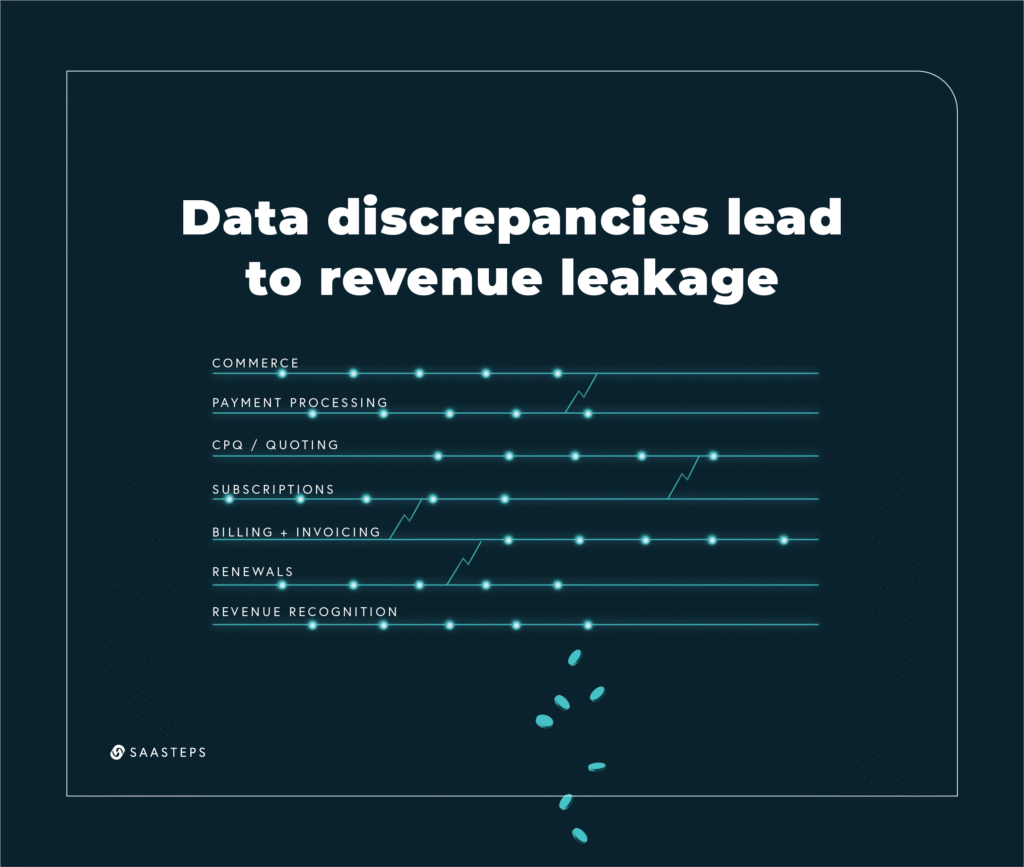
Fragmented revenue operations systems lead to operational inefficiencies, resulting in hidden costs such as reduced productivity, increased training expenses, and lost revenue opportunities due to poor data visibility across disconnected platforms.
Fragmented systems create blind spots that conceal vital data, making it challenging to predict revenue accurately. Research shows that businesses effectively utilizing integrated CRM systems, such as Salesforce, can experience increased revenue through enhanced customer data analytics (Kaliuta, 2024).
Juggling multiple platforms can confuse users and make it tough to get everyone on board.
Data Silos Create Forecasting Blind Spots And Decision-Making Delays
When revenue operations systems don’t talk to each other, it’s like trying to drive a car with blindfolds on. Data silos create serious blind spots that hinder your ability to forecast accurately and make swift decisions. Research by Hayes and Kelliher reveals that businesses failing to integrate their technology solutions experience significant data gaps, resulting in delays in decision-making and missed revenue opportunities (Hayes & Kelliher, 2024). These disconnections result in delayed insights, missed opportunities, and slower growth. With fragmented data, your team wastes time chasing information instead of acting on it. This chaos is especially true when dealing with quoting, billing, and renewals, where precision and timing are vital.
Let’s break down the costs of these silos:
| Issue | Impact |
| Delayed Data | Slower decision-making |
| Inaccurate Reports | Poor forecasting |
| Missed Opportunities | Lower revenue |
| Increased Errors | Customer dissatisfaction |
| High Admin Costs | Reduced operational efficiency |
At SAASTEPS, we’ve seen firsthand how unifying revenue operations eliminates these blind spots. By consolidating data into a single, cohesive system, you gain real-time insights, streamline processes, and boost accuracy. This integration ensures that every piece of your revenue lifecycle works together seamlessly, from quoting to renewals. Don’t let data silos hold you back; empower your team with a unified approach that drives efficient, scalable growth.
Operational Inefficiencies From Disconnected Tools Impact Team Performance
Operational inefficiencies often lurk beneath the surface, silently draining productivity and profits. Disconnected tools for quoting, billing, and renewals require teams to juggle multiple platforms, resulting in confusion and wasted time. Each tool may have its own data management system, resulting in inconsistencies and errors that can ripple through sales operations.
For instance, a quote generated in one system might not sync accurately with the billing platform, resulting in incorrect invoices. Such issues burden finance teams with manual reconciliations, slowing down the revenue cycle. Companies that implement integrated platforms can achieve operational cost reductions of up to 25% by eliminating these inefficiencies (García et al., 2021).
Furthermore, disjointed tools hinder real-time visibility, making it challenging for management to spot bottlenecks or capitalize on upsell opportunities. This fragmentation not only complicates data management but also hinders team collaboration, as information is not shared seamlessly across departments.
Teams often work in silos, duplicating efforts and missing out on the benefits of collective insights. This operational chaos is a stark contrast to the streamlined efficiency that unified systems offer, highlighting the urgent need for integrated revenue lifecycle management solutions.
Training Complexity And User Adoption Challenges Across Multiple Platforms
Until teams grasp the full scope, the costs of running fragmented revenue operations systems often go unnoticed. The challenge isn’t just about financial expenditure; it’s deeply rooted in the intricacy of training and user adoption difficulties. When your teams juggle multiple platforms, efficiency plummets.
This creates:
- Confusing Workflows: Different systems for quoting, billing, and renewals require users to learn and adapt to various interfaces and processes, increasing the likelihood of errors and downtime.
- Lack of Integration: Disjointed tools fail to communicate seamlessly, resulting in data inconsistencies and a disrupted workflow.
- High Training Overheads: Each new tool requires its own set of training sessions, manuals, and support resources, stretching your budget and team’s bandwidth thin.
With SAASTEPS, we simplify this mess. Our unified application downloads into your existing Salesforce platform and investment which eliminates these intricacies, ensuring that your team adopts the solution quickly and efficiently. Every aspect, from quoting to renewals, operates within a single data model, within your Salesforce platform, making training straightforward and user adoption easy.
There’s no need to navigate multiple interfaces or worry about data integrity. Our solution is built to drive your revenue operations effortlessly, letting you focus on what truly matters; growing your business.
Why Unified Systems Excel At Scaling Revenue Operations
Unified systems outperform fragmented ones in scaling revenue operations. Centralizing data architecture enables predictable revenue growth, allowing businesses to plan and invest with confidence.
Streamlined automation workflows boost cross-functional efficiency, ensuring every team contributes to revenue success.
Centralized Data Architecture Enables Predictable Revenue Growth
In the domain of revenue operations, data chaos is a familiar foe. Disparate systems and siloed data hinder revenue predictability, making it challenging to steer your company confidently.
Centralizing data solves this. With a unified architecture, every bit of information is easily accessible and actionable.
Take three key benefits:
- Single Source of Truth: All your data resides in one platform, ensuring consistency and accuracy – no more guesswork or conflicting reports. Standard and Custom Reports are rooted in data, all of which is stored inside your Salesforce CRM.
- Real-time Visibility: See what’s happening as it happens. Spot trends, identify issues, and seize opportunities swiftly with different data driving different Salesforce Reports and Dashboards.
- Informed Decisions: With reliable data at your fingertips, you make better calls on pricing, sales strategies, expansion, and renewals.
At SAASTEPS, we believe in the power of centralized data, within a single data model, and working within a single platform (Salesforce) is what ensures data clarity. In structuring your business this way, Salesforce becomes the backbone (our platform), while SAASTEPS helps companies untangle their data mess and drive predictable revenue growth through our streamlined Revenue Operations.
We want to help reduce your chaos. Today is the day to take back control with a centralized data architecture and a single data model for revenue operations.
Streamlined Automation Workflows Drive Cross-Functional Efficiency
When it comes to scaling revenue operations, sheer human power isn’t the answer. The key lies in streamlined automation workflows that boost cross-functional efficiency. Inefficient systems with manual handoffs lead to delays and errors, creating a domino effect that hampers revenue growth.
This is where technology seamlessly integrates, enabling actionable data to automate repetitive tasks and streamline everything. For instance, SAASTEPS’ platform automates complex quoting processes, ensuring accurate and swift CPQ responses.
Automation doesn’t just stop at quoting; it extends to billing and renewals, ensuring seamless handoffs and capturing every billable moment. By integrating all revenue operations into a single, unified system, teams can avoid the pitfalls of disjointed tools.
This comprehensive approach provides real-time insight, encouraging smoother collaboration. Intelligent automation doesn’t replace human intelligence but augments it, enabling teams to focus on strategic tasks that drive growth.
The result? Faster revenue velocity, reduced operational intricacy, and scalable growth.
Enhanced Customer Journey Management Through Integrated Touchpoints
As businesses grow, managing customer interactions becomes increasingly complex. The customer journey is becoming longer and more intricate, making it a challenge to guarantee a seamless experience. This is where integrated touchpoints come in. These allow businesses to deliver a cohesive customer journey from start to finish.
Integrated touchpoints guarantee every interaction is accounted for:
- Each customer contact builds on the last, offering a consistent experience.
- Data flows seamlessly, reducing manual data entry and errors.
- Teams work together more effectively, knowing exactly where customers are in their journey.
With integrated touchpoints through our application, SAASTEPS, every part of the customer journey fits together tightly—no more jumbled data, confused customers, or disjointed teams. Simplify the journey, manage it, and watch customer satisfaction grow.
Strategic Implementation Of Unified Revenue Operations Systems
When scaling revenue operations, many companies struggle with misaligned processes and disjointed technology.
A unified revenue operations system can fix this, but only if you first assess your current tech stack and process alignment.
Balancing technology integration with employee training guarantees smoother progression and better outcomes.
Assessing Current Technology Stack And Process Alignment
To successfully implement a unified revenue operations system, businesses must first confront the hard truths of their current technology stack and process alignment. This assessment is vital for identifying gaps that hinder data analytics and process optimization.
Often, companies find themselves juggling disparate tools for quoting, billing, and renewals, leading to siloed data and inefficient workflows. Here’s what you need to evaluate:
- Tool Proliferation: Count the number of tools used for revenue operations. More tools mean more intricacy and potential data leakage.
- Data Silos: Verify if data is scattered across various platforms, making it challenging to gain a unified view of the customer lifecycle.
- Manual Processes: Identify any manual processes that can be automated to reduce errors and speed up the revenue lifecycle.
Confronting these challenges head-on allows businesses to unwind unstructured data systems and pave the way for a smoother transition to a unified revenue operations application like SAASTEPS.
Balancing Technology Integration With RevOps Talent Development
Implementing a unified revenue operations system isn’t just about plugging in new technology; it’s about enabling your team to use it effectively. Many companies focus solely on the technology infrastructure, overlooking the critical need for talent development.
To maximize your investment in revenue operations, you must balance technological integration with empowering your team. This means providing thorough training and support to ensure everyone can navigate the new system with ease. Forward-thinking organizations are finding success by repurposing workforce capacity gained through technology improvements, rather than focusing on headcount reduction (Swan & Heuss, 2025).
Don’t fall into the trap of relying on technology alone to solve your quoting, billing, and renewals challenges. It’s often the people behind the tools who drive real transformation.
Invest in continuous learning programs that keep your team up-to-date with the latest features and best practices. By nurturing a culture of continuous improvement and aligning your team’s skills with your technology infrastructure, you’ll achieve seamless revenue lifecycle management.
Revenue Innovation Opportunities Through Data Unification
How can organizations transform their revenue lifecycle from a series of disjointed processes into a streamlined, efficient operation? The answer lies in data unification. By consolidating all revenue data into a single, cohesive system, businesses can eliminate silos and redundancies that hinder growth.
Data unification drives revenue growth by providing clear, actionable perspectives. It allows teams to see the complete picture, from quoting to renewals, without the chaos of disparate tools.
Here’s how SAASTEPS supports this transformation:
1. Streamline Processes:
By integrating quoting, billing, and renewals into one platform, SAASTEPS helps eliminate redundent manual tasks and errors. This means faster, more accurate revenue operations.
2. Improve Decision-Making:
With unified data, businesses gain real-time perspectives into revenue trends. This helps in making informed decisions that boost growth and customer retention.
3. Enhance Customer Experience:
A seamless revenue lifecycle ensures that customers have a smooth journey from purchase to renewal. This builds trust and loyalty, driving long-term revenue growth.
SAASTEPS simplifies complex revenue processes, making it easier for businesses to scale and thrive. It’s time to unwind siloed systems and embrace a unified approach to revenue operations.
Measuring ROI Beyond Revenue: Employee Engagement And Innovation Velocity
Measuring Return on Investment (ROI) often stops at revenue, but this narrow focus overlooks the broader impact on your organization. Employee engagement and innovation velocity are vital metrics that a unified revenue operations system can considerably improve. When your team isn’t wrestling with disparate tools and siloed data, they can focus on what they do best: driving growth and innovation. This is particularly crucial as 80% of enterprises now recognize customer experience as a critical factor in their operational decisions affecting business performance (Information Services Group, 2024).
Consider the following benefits:
| Before Unified System | After Unified System | |
| Quote Generation | Manual, time-consuming | Automated, quick |
| Billing Accuracy | Error-prone, delayed | Precise, on-time |
| Renewal Rates | Low, disorganized | High, streamlined |
| Employee Morale | Frustrated, overworked | Engaged, productive |
| Innovation Pace | Slow, stagnant | Fast, agile |
With SAASTEPS, you don’t just streamline your revenue lifecycle; you enable your team. You boost morale by eliminating tedious tasks and cultivate a culture that values high-impact work. Furthermore, you accelerate innovation velocity. When your team isn’t bogged down by manual processes, they can identify new opportunities and implement better strategies faster. Don’t overlook these essential benefits when considering your ROI. Transform your revenue operations, and watch your entire organization thrive.
Frequently Asked Questions
What Is the Learning Curve for Transitioning to a Unified System?
The learning curve for shifting to a unified system varies depending on the intricacy of the existing tools and the team’s familiarity with integrated platforms. Typically, initial training and adjustment may take a few weeks to a few months, but the long-term benefits often outweigh the short-term modification period. Key factors include thorough onboarding, continuous support, and intuitive system design, which mitigate the challenges of transition. Streamlined processes and consolidated data in a unified system enhance efficiency and reduce operational friction, resulting in a smoother learning curve compared to managing disparate tools.
Can Unified Systems Handle Unique Industry-Specific Requirements?
Unified systems, like SAASTEPS, can handle unique industry-specific requirements through flexible pricing models, dynamic quoting, and configurable subscription plans. The platform’s Salesforce-native architecture allows for customizations without additional code or integrations, ensuring adaptability to diverse industry needs. The single-data model further supports industry-specific analytics and reporting.
How Does a Unified System Ensure Data Security and Compliance?
In a unified system, data security and compliance are guaranteed through enterprise-grade security measures, built-in regulatory compliance features, and transparent audit trails. Centralized data minimizes risk by reducing data transfer points and maintaining a single, secure data model.
Conclusion
Unified systems aren’t just a nice-to-have; they’re a must-have. Fragmented tools seem easy, but they create more problems than they solve. They slow you down, make mistakes likely, and hide important info. With a unified system, you see everything clearly. You move faster, make better calls, and grow smarter. Don’t let scattered tools hold you back. Take control, get aligned, and watch your revenue operations soar.
References
García, J., Martín-Díaz, O., & Fernández, P. (2021). A flexible billing life cycle for cloud services using augmented customer agreements. IEEE Access, 9, 44374-44389. https://doi.org/10.1109/access.2021.3066443
Hayes, Ó., & Kelliher, F. (2024). The role of social media data in enhancing B2B omni-channel marketing efforts in small businesses. Journal of Small Business and Enterprise Development, 32(1), 151-172. https://doi.org/10.1108/jsbed-02-2023-0051
Information Services Group. (2024, April 30). Customer experience drives workplace decisions, ISG research finds. https://ir.isg-one.com/news-market-information/press-releases/news-details/2024/Customer-Experience-Drives-Workplace-Decisions-ISG-Research-Finds/default.aspx
Kaliuta, K. (2024). Economic benefits of using Salesforce in business: Analysis and practical recommendations. Futurity Economics & Law, 83-99. https://doi.org/10.57125/fel.2024.06.25.05
Swan, D., & Heuss, R. (2025, March 11). Powering productivity: Operations insights for 2025. McKinsey & Company. https://www.mckinsey.com/capabilities/operations/our-insights/powering-productivity-operations-insights-for-2025